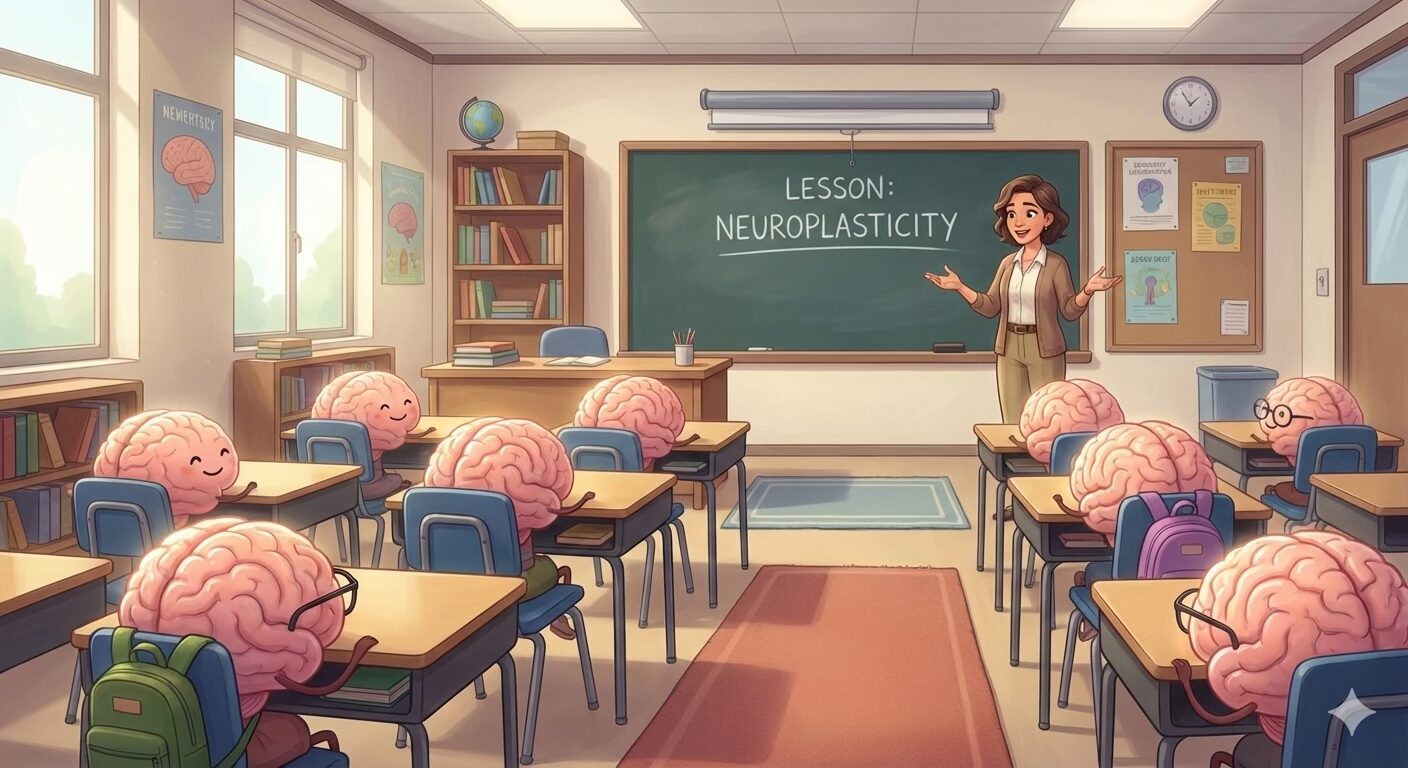
Designing Schools for the Brains Inside Them
A Neuro Informed Look at Youth Mental Health and School Systems
I was reading news article one morning, my oatmeal cooling faster than I intended, when my brain wandered into the ‘What If’ game.
Not the spiraling seven-year-old kind. Just a slow, curious What if…
The article I was reading laid out the case plainly. One in five children in the U.S. lives with a mental health condition. Schools are being asked to do more and more to meet student needs. Many students still can’t get the help they need. Staff and funding are stretched to the max. The need for mental health support is real and growing, and the systems meant to provide it are not simple or easy to navigate.
And somewhere between the statistics and the strategy recommendations, my mind drifted.
What if Neuro Informed thinking was the operating system underneath all of this.
Not a new initiative. Not another program layered on top of already crowded plates. Just the background logic shaping how schools are designed, how adults interpret behavior, how support shows up long before a referral is ever written.
That question stuck with me. Not because the numbers surprised me. They didn’t.
It stuck with me because schools are not neutral delivery sites for services. They are daily environments where brains are constantly learning what to expect from the world. They shape predictions about safety, effort, belonging, and whether support is something you can rely on or something you hope appears if conditions are right.
I hope I don’t lose you, but when we talk about school-based mental health, we often frame the challenge as a service problem. How do we expand access? How do we coordinate care? How do we get evidence-based interventions into buildings that are already stretched thin.
Don’t get me wrong, those are important questions.
And at the same time, something else is going on. Every school day is training the brain. Every bell schedule. Every hallway interaction. Every response to distress or disruption teaches young nervous systems how the world works.
That is the part that kept tugging at me as I read the piece from McKinsey & Company.
We know the brain is like a weather forecaster. It is always scanning the sky. Looking for patterns. It is constantly updating its picture of what is happening so it can decide how much energy to use and how careful to be. When things feel stable, it can relax. When things feel shaky, it tightens up. When life stays unpredictable for too long, the system stays on edge even when nothing seems wrong.
Now place that forecaster inside a school.
When a student’s needs are met again and again, they learn that their signals matter. When they ask for help, someone responds. Adults act in ways they can understand and rely on. Things start to feel more predictable. That frees up energy for learning, playing, and connecting with others.
When a student’s needs are met only sometimes, they learn a different lesson. Help feels unpredictable. Asking for support can feel risky. Things change without warning. Nothing ever quite feels right, so the brain stays on guard, always preparing for the next storm.
That preparation shows up as behavior. As fatigue. As disengagement. Often as all of it at once.
The McKinsey article focuses on the urgent need to expand mental health services in schools. It notes the staffing shortages, funding constraints, and coordination challenges that make this work hard. Those realities are undeniable. Anyone close to education feels them daily.
What caught my attention is how those gaps shape expectations over time.
When access to care is delayed or fragmented, the brain updates its model. It learns that relief is unpredictable. That systems move slowly. That you might need to endure before anyone notices. Those lessons do not stay contained within mental health support. They bleed into how kids approach learning, relationships, and authority.
Yes, clinical services are super important. Trauma informed practices matter. Behavioral supports matter. Motivation, leadership, skill building, all of it has value.
AND
Neuro Informed thinking invites us to widen the lens.
Instead of only asking how we deliver services, we also ask what kinds of predictions our systems are teaching brains to make.
A whole system approach understands that the environment plays a big role in helping people stay regulated, whether that is on purpose or not. When routines are predictable, it takes less energy to get through the day. Clear transitions reduce confusion and stress. When adults respond in calming and consistent ways during tense moments, they help nervous systems calm down before things escalate.
This does not replace therapy. It supports it.
A Neuro Informed framework acts as a bridge between clinical insight and everyday design. It helps translate what we know about brains into how we structure time, space, expectations, and relationships in schools.
The McKinsey article focuses on expanding proven supports. I keep thinking about expanding a sense of safety around what to expect. Creating environments where brains can better predict what is coming next. Places where fewer kids start the day already on edge, waiting for something to go wrong.
Brains do not wait for services to begin learning. They learn constantly. From how mornings start. From how mistakes are handled. From whether adults explain change or simply enforce it. From whether stress makes the system more rigid or more flexible.
That learning accumulates behind the scenes. Over time, it becomes a worldview.
If we want different outcomes, we have to pay attention to the predictions being formed, not just the interventions being offered. We have to care about how the system feels to live inside, not only how it performs on paper.
I do not have a tidy ending for this. I am still sitting with the ‘What if’.
So, I will leave you with a couple of questions instead.
As schools take on a bigger role in supporting youth mental health, what kind of weather are we helping young brains learn to expect?
And what might shift if we designed with that forecast in mind.
P.S. If you want to read the article that sparked this whole What If spiral, it is titled Addressing Youth Mental Health through School Based Services from McKinsey, published June 24, 2025. You can find it here: https://www.mckinsey.com/industries/education/our-insights/addressing-youth-mental-health-through-school-based-services